


 Dec 17, 2025
 3 min read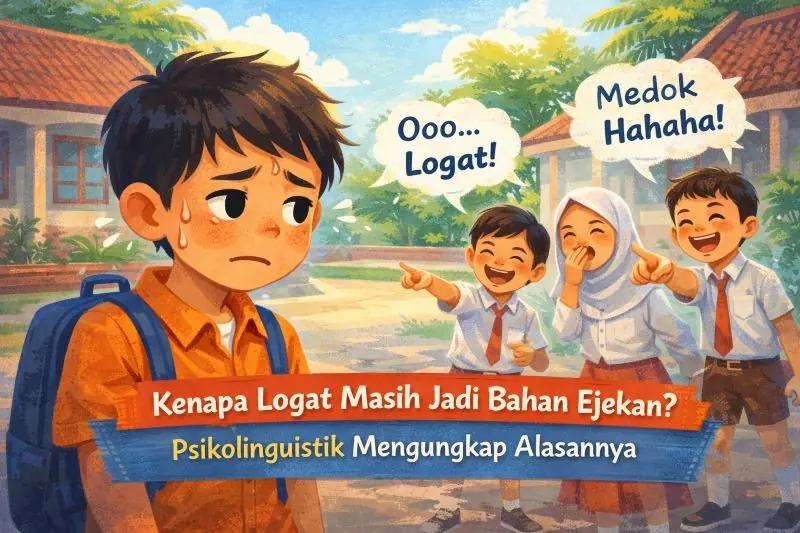
This is probably something that happens to almost all foreigners, but as soon as I say a sentence or two, "Is this really the Medoc?"or "Wow, what's that accent?"Funny at times, but…
Illustration.Generated by AI
Author: Oriza sativa
Perhaps it is something that almost all foreigners experience, after saying a sentence or two, the comment "Really sweet, huh?"or “Wow, what accent is this?”is sometimes funny, but often feels judgmental.It's as if our speaking style determines how appropriate we are in the environment.In fact, we never choose the accent we use.still often the subject of jokes.Why does this happen?
Why does our brain become "numb" after hearing new abuses?
It turns out that this phenomenon has something to do with how our brains work.Citing the journal Frontiers in Psychology, a study titled Linguistic Processing of Uttered Speech Across the Lifespan found that the human brain processes familiar utterances faster than new utterances.Children can learn to recognize different or unfamiliar accents, but they recognize words more quickly with the accent they hear more often.
Adults also experience the same thing, our brain takes more time to adjust when we hear a new accent for the first time. Once you get used to it, understanding will increase. This means that it's normal to feel "surprised" or "confused" when you hear a new accent, it's not really the accent speaker's fault, it's because our brain is adjusting.
When brain processes turn into bullying
Problems arise when feelings of surprise, unfamiliarity, and confusion become stigmatized.A study titled Social Factors in Accent Recognition: A Large-Scale in Perceptual Dialectology, cited in the Journal of Linguistic Geography, reveals that listeners want to understand their native accent.The more similar the speaker's and listener's words are, the easier it is to understand.On the other hand, the greater the similarity, geographic region, and social sector, the more difficult the accents are to distinguish.
As a result, we often think of our own accent as "standard," and other people's accents as "weird," making them the subject of ridicule.Without definition, we create unfair "language castes," where some accents are considered more "common" and "modern," while others are considered "weird."In fact, linguistically, no accent is superior to another accent.
The psychological impact is no joke
Cited from Airlangga University's repository, The Meaning of Regional Dialect Discrimination: A Phenomenological Study of Speaker's Perspectives on Regional Dialect Discrimination in Indonesia revealed a similar phenomenon.
Some of them chose to laugh at themselves in order not to get angry, while others tried to calm down the speech or imitate the style of speech in Jakarta.There are those who are forced to "hide" their regional identity when they are in a new place, especially in a big city.Ironically, even though they understand that stigmatization hurts, people still think they are "natural."This shows that the stereotypes are deeply rooted, which makes a person insecure about himself.
I also had a similar experience as a Minang person.When I first studied in Jakarta, my friends laughed at me when I couldn't pronounce the sound of the letter "E".For the Minang, distinguishing between "e" in the word "enak" and "é" in the word "emak" is not easy.Simple things like this can make us feel inferior when speaking in front of many people.
The psychological impact is no less serious.Many immigrants experience an identity crisis, feel insecure when they speak and some even choose to remain silent rather than deal with comments from others about their accent.It is not only a question of language, but also a question of self-esteem and social acceptance.
Social media: changing the narrative around slang
Social media offers a different perspective.The distinctive accents of many content creators such as Makassar, Batak, Javanese, Eastern, Minang and other accents make them go viral.From the looks of it, audiences seem to really enjoy the authenticity.It makes people realize that an accent is not a quirk but a cultural flavor that makes a person unique.
Platforms such as TikTok, Instagram, and YouTube have become visible places where regional radio is seen as a value.Content creators have bold accents with strong colors that are easy to remember and love.This can be proof that young people are starting to develop different opinions about accents and languages in Indonesia, although some still laugh at regional accents.
It's time to celebrate, not laugh
This shows that the problem is not the accent, but the way we perceive it.We often forget that each accent has a history, cultural background, hometown, and childhood.Making fun of an accent is like making fun of someone's identity.Accents are a cultural heritage that continues to evolve and is passed down from generation to generation.
Indonesia has more than 700 regional languages with thousands of dialect variations.It’s actually a treasure that many countries don’t have.Instead of being funny, we should be proud of the fact that in one country we hear many different colors of voices, melodies and melodies.
The question now is: "Why is it still made with someone's accent, if we are proud of the diversity of Indonesia?"Change can start with simple things, like stopping making derogatory comments about someone's accent and starting to see it as part of a cultural wealth to be proud of.In addition, we can also begin to raise awareness of respect for differences, the impact of the words we say, and teach the next generation that the accent is an identity, not a shame.
The author is a student at UIN Syarif Hidayatullah.
There are no comments yet.Be the first!